Trends
Analyst Blog: The Three CRM Criteria Mid-Market Manufacturers Keep Getting Wrong
4
min read

Churn in Manufacturing Shows Up in Order History Before It Shows Up in a Conversation
In a software business, churn announces itself. A customer stops logging in, opens a cancellation ticket, or misses a renewal conversation. In manufacturing, a customer stops placing orders at the same frequency they used to, or shifts volume to a competitor one product line at a time, while continuing to place some orders and maintaining a cordial relationship with the account manager.
By the time that churn registers as a CRM activity signal, the account is already partially lost. The signal was in the order history the whole time. A three percent drop in monthly volume from a key account is not noise. It is a warning that the enterprise resource planning system contains and the CRM has no visibility into.
Platforms that surface these signals require native integration between enterprise resource planning transactional data and the CRM intelligence layer. That is not a standard feature. It is a product decision that distinguishes vendors who have genuinely built for manufacturing from those who have adapted a horizontal platform and called it an industry solution.
The platforms that score highest on standard CRM review sites are often not the ones that handle these three criteria well. The inverse is also true: platforms built specifically for manufacturing sales complexity do not always win on adoption speed or interface polish.
SugarAI (formerly SugarCRM)
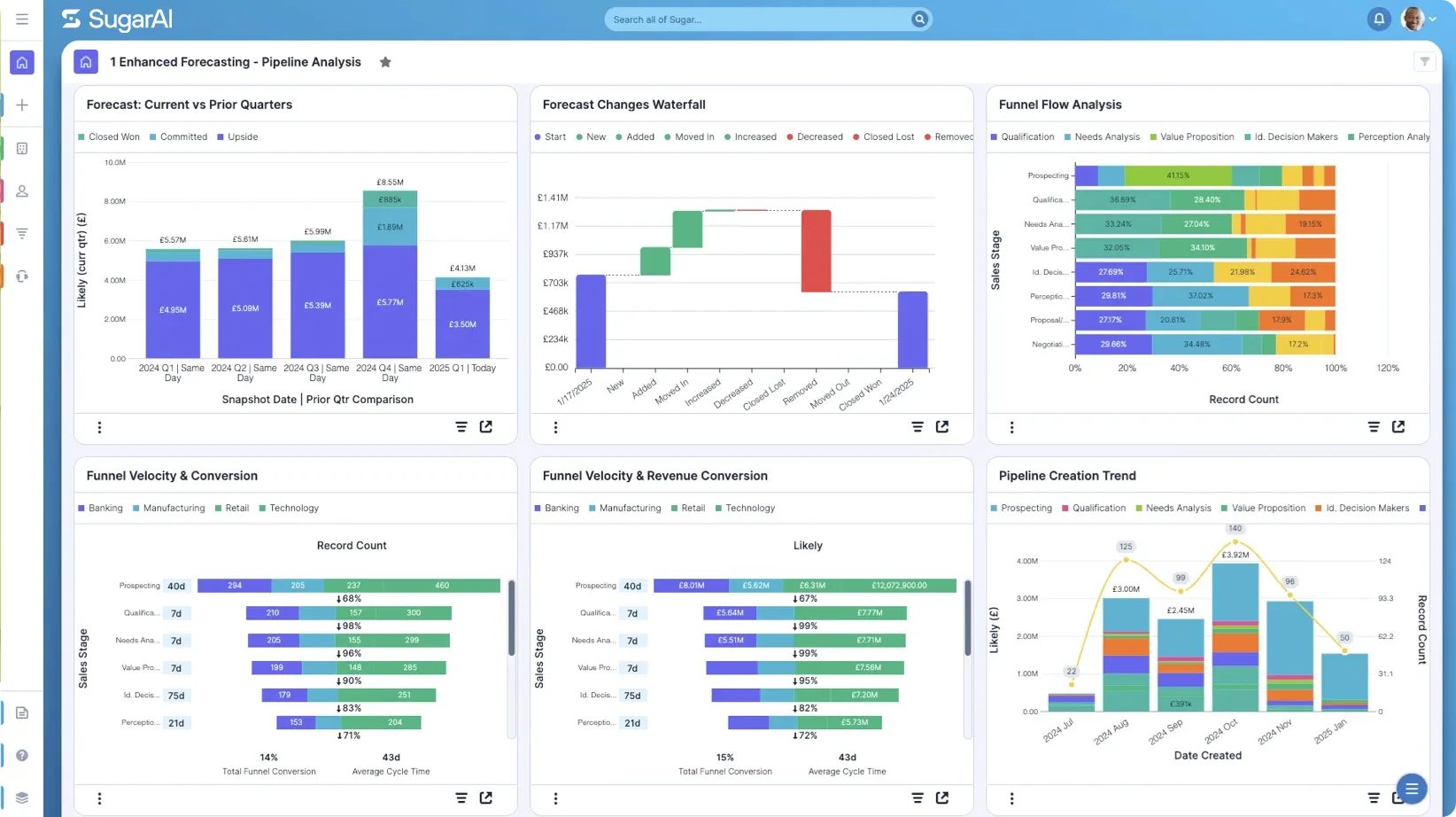
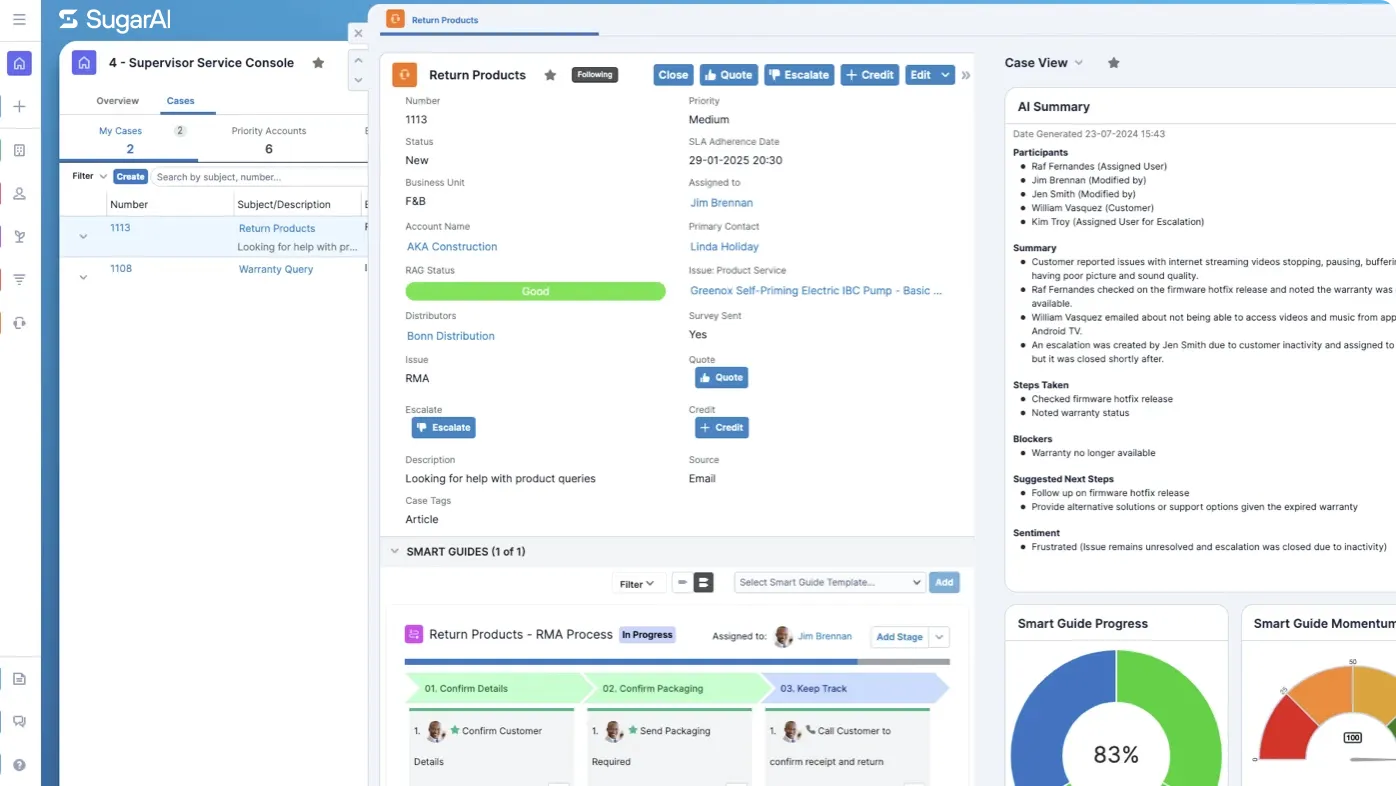
The platform most explicitly built around the three criteria above. The April 2026 rebrand from SugarCRM to SugarAI marked a formal commitment to what the company calls precision selling, defined as using enterprise resource planning transactional signals to guide sales action rather than pipeline activity alone. The 2024 acquisition of sales-i, a revenue intelligence platform built specifically to analyze enterprise resource planning data for manufacturing and wholesale distribution, added a capability that most CRM vendors would take years to replicate organically. Sales-i completed full integration with Sugar Sell in May 2025, meaning the churn signal detection capability, identifying accounts whose order frequency or volume has shifted, now runs natively within the CRM workflow rather than requiring a separate login. The ERP data ownership architecture is addressed explicitly through the platform's middle-tier integration model. For manufacturers running Epicor Kinetic specifically, the integration story is more developed than for most CRM platforms. Technology Coast Partners, holding both SugarAI Premier Partner and Epicor Elite Partner status, ships a dedicated product called Fluent that connects Epicor Kinetic and SugarAI. Release 2026.1 was announced at Epicor Insights in Nashville in May 2026. That is a production-ready, maintained connector with a version history, not a custom integration project quoted fresh for each deployment. Manufacturers already on Epicor Kinetic evaluating CRM should treat this as a meaningful differentiator. The real limitation for mid-market operations is that the broader partner ecosystem, outside the Epicor channel, is thinner than Salesforce's, and implementation quality varies. Sugar Sell holds a 2026 Emotional Footprint Champion award in the SoftwareReviews midmarket CRM category, based on 146 verified user reviews. Best fit for mid-market manufacturers with between 20 and 500 sales team members who run heavy repeat-order and run-rate business, particularly those already operating on Epicor Kinetic.
This article was originally published on: https://www.shashi.co, by industry analyst Shashi Bellamkonda at InfoTech.
Share article